
11/18/26
Collaboration Is Not a Room. It’s a Behavior.
Better collaborative spaces begin with understanding what people need to do together—not simply where they meet.
For years, we’ve talked about collaboration as if it were a destination: the conference room, the huddle space, the classroom, the project table. But putting people in a room together does not automatically create collaboration.
Real collaboration happens when people can share an idea, make it visible, challenge it, build on it, step away to think, come back with a different perspective, and ultimately turn conversation into action. The physical environment can’t create that behavior on its own, but it can make it significantly easier.
That distinction matters. It’s the right question to start with when determining what a space needs to support.
Start With the Behavior, Not the Room Name
A traditional floor plan tells us what a space is called. A better planning process starts by asking what people actually need to accomplish there.
Do they need to generate ideas? Make a decision? Learn from one another? Share information quickly? Solve a problem together? Connect informally? Work independently for a period and then rejoin the group? Those activities do not all require the same environment.
A productive collaboration might be two people sketching at a writable wall. It might be a project team moving tables together for an hour and separating again later. It might be a teacher shifting students between instruction, small-group work and individual focus. In healthcare, it can mean helping teams communicate essential information while maintaining privacy. In another setting, it may simply be an unplanned conversation in a lounge, café or outdoor space that solves a problem faster than a scheduled meeting could.
When we design around behavior, solutions are easier to find—and they support better work.
Five Conditions That Help Collaboration Work
There is no single formula for a collaborative environment. But successful spaces tend to address several fundamental human needs.

Make Thinking Visible
Ideas become easier to discuss when everyone can see and interact with them.
A writable surface, shared screen, tackable surface or digital canvas can turn an individual thought into something the group can examine together. The technology itself is not the point. The value is creating a shared reference that lets people contribute, question and build on the same idea to fuel progress and momentum.
Make Change Easy
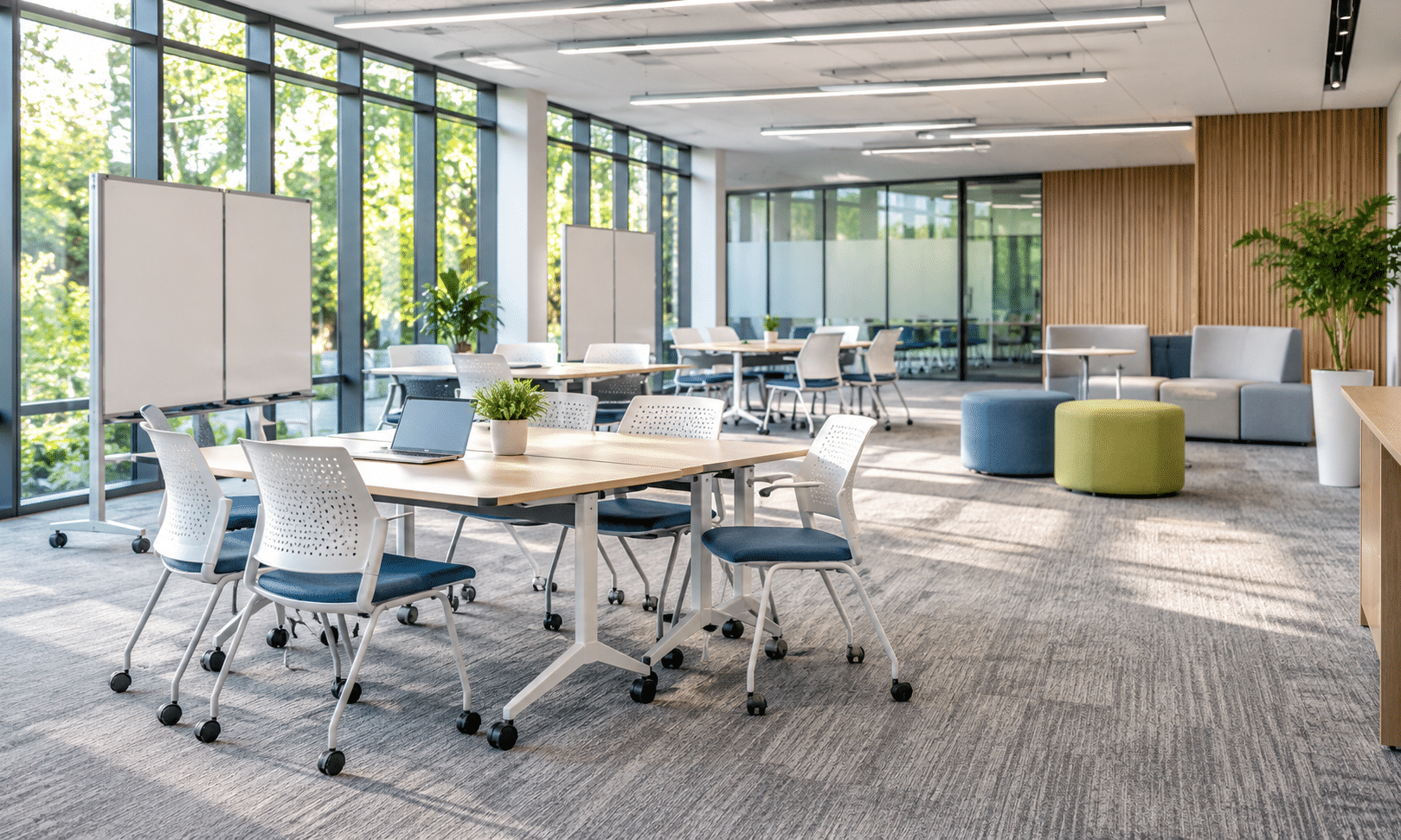
The work changes. The space should be able to respond.
A team might begin with a presentation, break into smaller conversations, regroup around a shared surface and finish with individual follow-up. If changing the room requires facilities support or fifteen minutes of moving furniture and reconnecting cords, flexibility exists in theory but not in practice.
True adaptability is practical. Mobile furnishings, accessible power, thoughtful storage, clear circulation and simple technology help people change the setting without disrupting the work.
The better question is not simply, “Can it move?” It is, “Can the people using the space easily make it work for what they need to do next?”
Design for Connection (Including the People Who Aren’t in the Room)
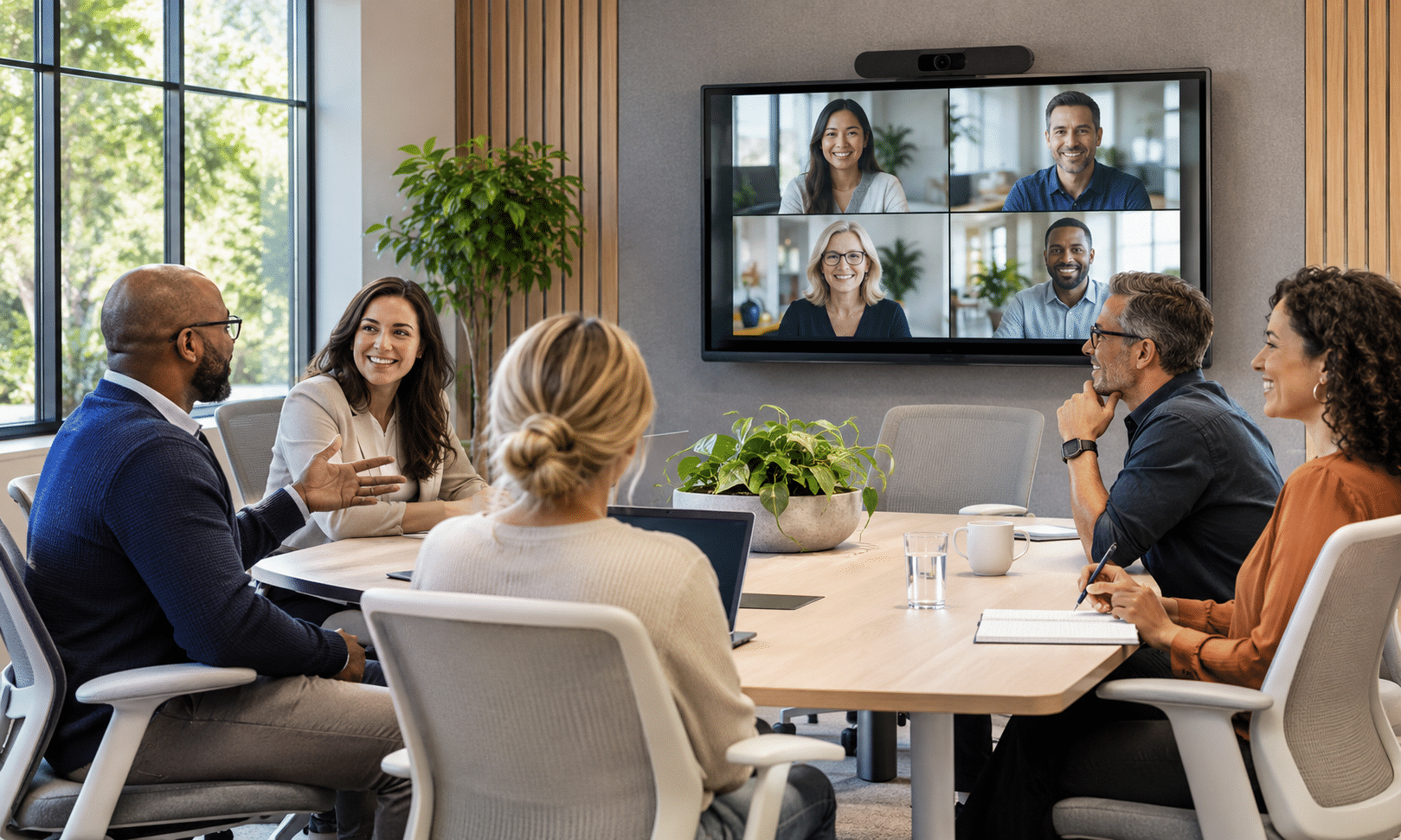
Hybrid work changed the meaning of presence.
Collaboration now has to work for the person sitting across the table and the person joining from another location. That makes sightlines, acoustics, camera placement, displays, power and access to shared content part of the spatial design—not technology decisions added after the furniture arrives.
A room that works beautifully for the people physically present but leaves remote participants watching from the edge is not fully collaborative.
Anyone who has joined a remote meeting knows the goal should be participation, not simply connectivity. Otherwise, remote participants are left watching the rest of the room.
Protect Focus as Part of Collaboration
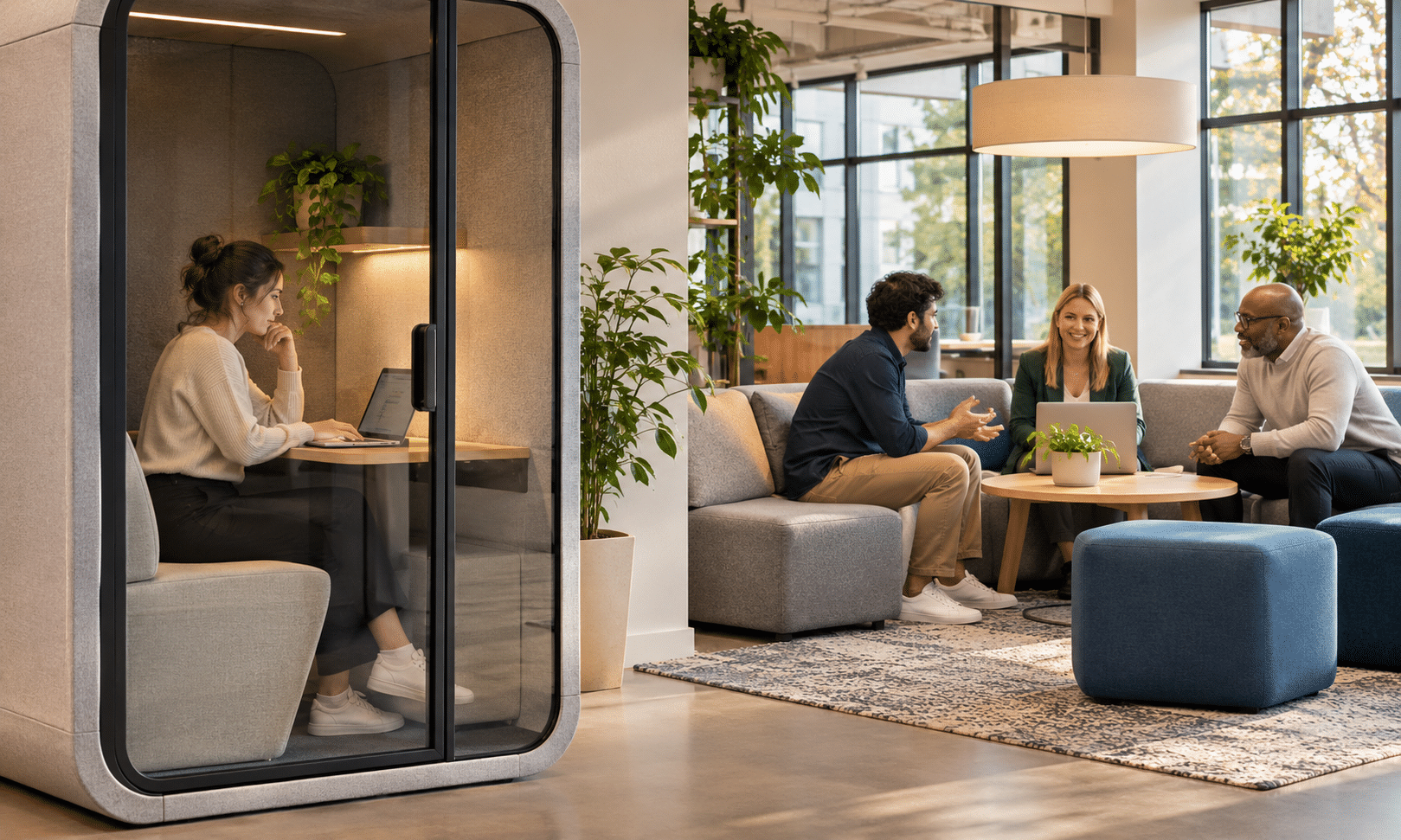
Collaboration and concentration are often discussed as opposing workplace needs. In reality, they depend on each other.
Good collaborative work often includes periods of individual thought. People need to absorb information, prepare, write, analyze and develop their own point of view before returning to the group.
That means an effective collaborative environment is rarely one endlessly open landscape. It is a range of settings: places to gather, places to think, places for private conversations and places where people can move between those modes without unnecessary friction. Acoustics, visual privacy and choice matter just as much as the collaborative table itself.
Create Conditions for Belonging
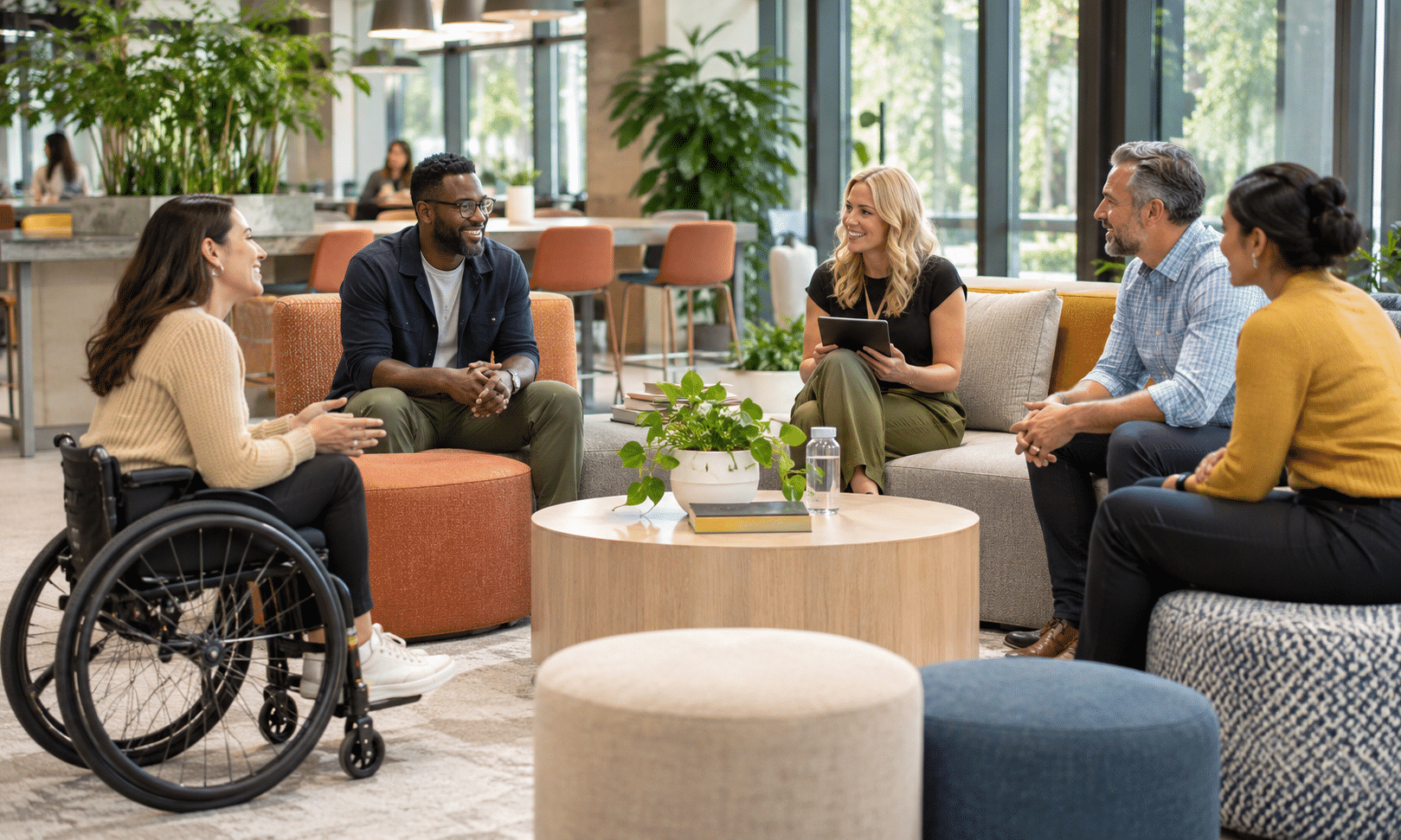
People are more likely to contribute when they feel comfortable joining the conversation.
That makes accessibility, ergonomics, sensory comfort and choice part of the collaboration strategy. Some people think best while moving. Some need a quieter setting. Some engage easily in a large group; others contribute more effectively in a smaller conversation before joining the whole.
Design does not need to force everyone into one way of working. It should create enough meaningful choice that more people can participate successfully.
The objective is not maximum interaction. It is better interaction.
Collaboration Happens Everywhere
One of the most important shifts in planning is recognizing that collaborative behavior is not limited to corporate offices.
Education
Environments that can shift between instruction, exploration, group work and individual focus without losing valuable learning time.
Healthcare
Settings that help caregivers communicate quickly and clearly while giving patients and families understandable information and appropriate privacy.
Corporate Workplaces
A range of settings for focused work, informal exchange, structured meetings and hybrid participation.
Outdoor Spaces
Courtyards, patios and other areas intentionally planned for conversation, respite and creative work.
Different environments have different requirements. The common principle is simple: design around what people need to do together.
Products Should Support the Idea—not Become the Idea
Furniture, writable surfaces, technology, acoustic solutions, power and storage all matter. But none of them is collaboration by itself.
Their real value is in what they make possible for people.
A mobile table matters when it lets a room change quickly. A writable wall matters when it helps a team give an idea shape. Integrated power matters when people can work where the conversation naturally happens rather than arranging themselves around an outlet. Acoustic treatments matter when one group can exchange ideas without making it harder for someone nearby to concentrate.
This is why the best solution rarely begins with choosing a single product. It begins with understanding the experience people need and then bringing the right elements together around it.
A Better Way to Plan Collaborative Space
Before selecting products or assigning square footage, start with five practical questions:
Define the behavior before defining the space.
Consider information, ideas, technology and communication surfaces.
Think about different group sizes, activities and modes throughout the day.
Power, cords, acoustics, storage, technology, accessibility and furniture movement can support the experience or interrupt it.
Build concentration and privacy into the collaboration strategy rather than treating them as separate issues.
Those questions create a more useful starting point than, “How many conference rooms do we need?”
Design for What Happens Next
The most valuable spaces are not necessarily the ones with the most features. They are the ones that make the desired behavior feel natural.
When a team can move from conversation to visualization, from visualization to decision, and from decision to action without fighting the environment, the space is doing its job.
That is the opportunity for workplace design today: not simply to create attractive rooms, but to remove friction between people and the work they are trying to do together.
Because ultimately, collaboration is not a room, a table, a screen or a board. It is what happens around them.
At AAA Workspace Interiors, we help organizations translate the way people need to work, learn, communicate and connect into practical environments by balancing furniture, project realities and long-term value.
Ready to Start Collaborating?
If you are rethinking a workplace, classroom, healthcare setting or other shared environment, start with one challenge: What do your people need this space to help them do?
Let’s talk through that question together and build the right solution around it.
Contact AAA Workspace Interiors →Better Space. Better Work.